When you’re renovating a home, the kitchen budget is usually the biggest pill to swallow. It is incredibly tempting to look for ways to cut corners. If you browse the internet for advice, you will find endless articles debating modular vs. carpenter-made kitchens.
But that debate misses the real point.
The real question isn’t who builds your kitchen today; it’s how that kitchen will hold up five years from now.
In the first year, every kitchen looks stunning. The laminates shine, the drawers glide smoothly, and you feel like a budgeting genius. But around year five, cheap kitchens start telling their secrets.
1. The Anatomy of a 5-Year Breakdown
A kitchen is not like a living room sofa or a bedroom wardrobe. It is a high-stress, high-moisture, high-heat environment. It gets slammed, spilled on, and scrubbed daily. Low-cost kitchens are simply not built to survive this lifestyle for long.
Here is what typically starts failing around the five-year mark:
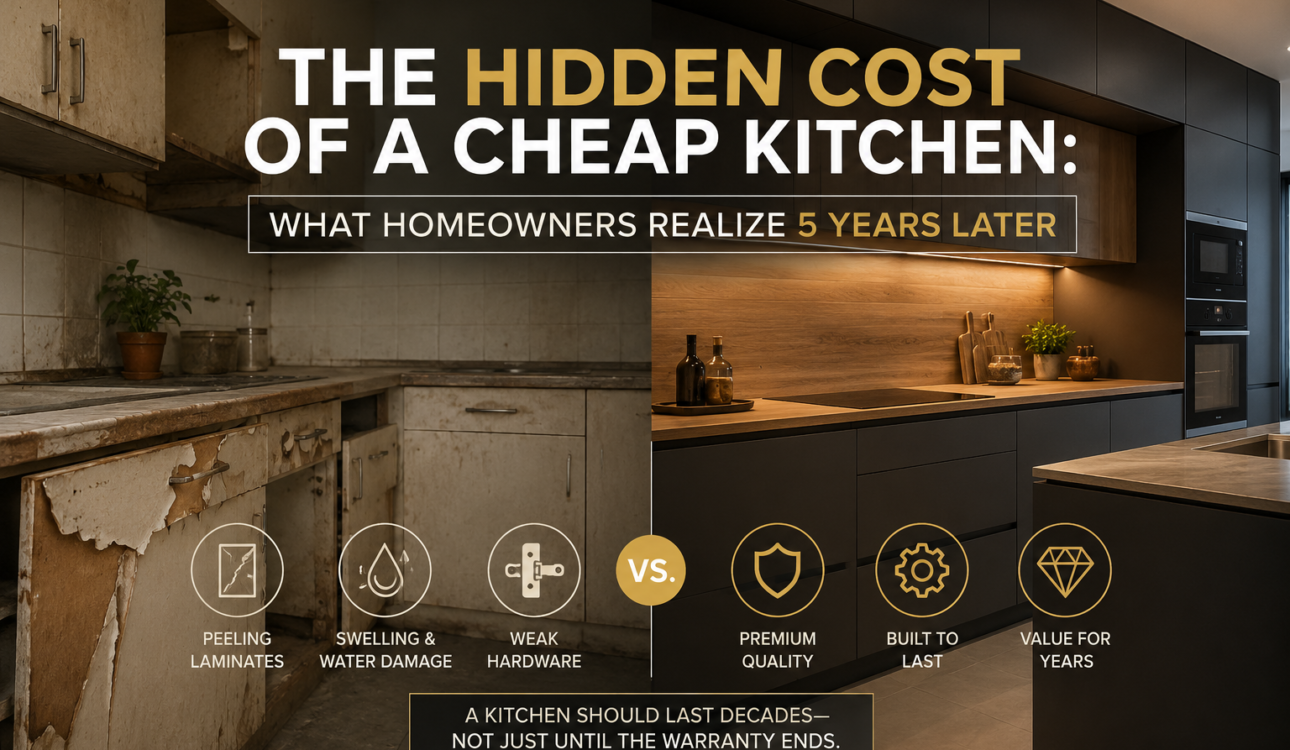
Cabinet Swelling: Cheap kitchens often use low-grade particle board or poorly sealed MDF (Medium-Density Fibreboard). The moment water seeps past the edges, which happens constantly near the sink and hob, the core absorbs moisture like a sponge. The wood swells, warps, and loses its structural integrity.
Peeling Laminates: Low-grade adhesives and cheap edge-banding (the strips that seal the edges of your cabinet doors) cannot handle the constant heat from cooking. Within a few years, you’ll notice the edges peeling back, exposing the raw wood underneath to even more moisture.
Weak Hardware & Sagging Drawers: The hardware is the unsung hero of a kitchen. Cheap hinges and drawer runners wear out fast under the weight of heavy pots and pans. By year five, drawers start scraping against the frame, doors hang crookedly, and soft-close mechanisms stop closing softly.
The Maintenance Trap: When these issues start, homeowners find themselves in a cycle of constant minor repairs. Fix a hinge today, re-glue a laminate next month. Over a decade, these annoying, repetitive maintenance costs can easily add up to the price of a premium kitchen.
2. The Premium Difference: Why German Engineering Lasts
When designers talk about “premium German engineering” in kitchens, they aren’t just talking about a luxury label. They are talking about rigorous, unforgiving manufacturing standards designed to combat the exact failures listed above.
What makes a premium engineered kitchen different?
Laser-Fused Edge Banding
Instead of using standard glue that melts under heat, premium German kitchens utilize zero-joint laser technology. The edge band is literally fused to the panel, creating a seamless, water-tight barrier that moisture cannot penetrate.
High-Density Materials
Premium kitchens utilize high-density, moisture-resistant core materials engineered specifically to handle high humidity without expanding or warping.
Hardware Tested for a Lifetime
Premium hardware (like Blum or Hettich) is tested for up to 200,000 opening and closing cycles. That translates to roughly 20 to 25 years of daily, heavy-duty use. They don’t sag, they don’t rust, and they don’t lose their alignment.
3. The Math: Investing Once vs. Paying Twice
Let’s look at a quick, realistic look at how the economics actually play out over a 15-year period.
| Feature | The Cheap Kitchen | The Premium Engineered Kitchen |
| Initial Cost | Low to Moderate | Higher Upfront Investment |
| Year 1–3 | Works perfectly; feels like a bargain. | Works flawlessly. |
| Year 4–7 | Swelling near sink; loose hinges; peeling edges. First major repair bills. | Functions exactly like Day 1. Zero maintenance. |
| Year 8–12 | Drawers misaligned; major aesthetic wear. Requires partial or full replacement. | Still looks and feels brand new. Minor adjustments at most. |
| Total Cost (15 Yrs) | Initial Cost + Repairs + Replacement Cost | Initial Cost Only |
The Verdict
A cheap kitchen is built to do one thing: look good in a showroom so it can sell quickly. A premium engineered kitchen is built to survive real life.
When planning your budget, remember that you aren’t just paying for cabinets and countertops. You are paying for the thousands of mornings you will open those drawers, the spills that will inevitably happen, and the peace of mind that comes with knowing your home is built to last.
A kitchen should last decades, not just until the warranty ends.